Showing posts with label Movie Review. Show all posts

4.11.2008

The Rolling Stones star in Shine a Light

Halfway through Shine a Light a reporter sticks his microphone towards Mick Jagger's baby-smooth face and asks the singer if he can imagine performing on stage when he's sixty. Without a hint of humor or cockiness The Rolling Stone's frontman replies, "Easily."


Warning: Staring at Mick Jagger's hips may cause impure dreams

Martin Scorsese inserts many such news clips throughout footage from two of The Stones' performances in New York City's Beacon Theater in late 2006. The result can barely be called a documentary because of its superficial nature that rarely delves deeper than Jagger and the band's wrinkled surface but the film nonetheless succeeds as an energetic tribute to The Stones' endurance and remarkable showmanship.

I can admit that I didn't know much Rolling Stones history walking into the theater and upon leaving I didn't know much more; Shine a Light isn't that kind of movie.

Even calling Shine a Light a movie is a bit of a stretch. The tagline on the film's poster reads "Experience it in IMAX" and "experience" is a far more accurate description of the film. Scorsese mercifully avoids a "Behind the Music" story arc and focuses primarily on the Stones' Beacon Theater performance and for the most part this works just fine, especially if you've never seen the band live and, even if you have, I guarantee that you've never seen them this close before.


Keith Richards looks fabulous for a ninety-four year old guy. Too bad he's actually sixty-four

Jagger, Richards, Watts, and Wood burst off the screen thanks to endlessly creative camera angles and borderline-obscene clarity. The camera work is akin to watching a Stones' live performance on a front row chair sprinkled in fairy dust that can swoop and float across the stage. The level of definition is equally incredible; close ups of Mick Jagger and Keith Richards' faces will leave you swearing you've accidentally wandered into a recreation of the moon landing.

But looking great is only one part of the equation and, thankfully, The Stones justify Scorcese's interest and prove they can still bring the noise. The band is loud and exhilarating and Mick Jagger is, bar none, the best sixty-something stage performer out there. He might not have the same vocal strength he used to, but his ability to prance and sing without degenerating into Darth Vader huffing is nearly as superb as his obvious physical conditioning. The man is ripped ten ways from Sunday.

Balancing out Mick Jagger's unnatural sinuous grace is Keith Richards' awkward "dance moves, " which include circling Ronnie Wood like a scuttling crab and flicking guitar picks into the audience. Meanwhile Charlie Watts never fails to look like a five-foot pole resides underneath his buttock and Ronnie Wood does his best Rod Stewart impersonation, but watching each band members' quirks is surprisingly entertaining.

Shine a Light would have been even more entertaining with additional archived footage to inject further texture into the performance. Martin Scorsese obviously wanted to make a film that was loud, fun, and easy to digest but he missed out on an obvious opportunity to give Shine greater staying power.

For example, Keith Richards sings vocals later in the set list. Musically, Richards' performance is the weakest portion of the concert and the film, but Scorsese offsets the lull by inserting more interviews. In one interview he and Ronnie Wood joke about who is the better guitarist and their banter flavors the glowing nods they threw each other while rocking out on stage. In another interview, Richards shies away from discussing his numerous addictions and dangerous lifestyle and credits his survival to luck. These snippets add extra wrinkles to The Rolling Stones' performance and infuse a greater sense of perspective and accomplishment. It's a shame more weren't included.

If you've already seen the Stones live or have watched a true documentary on the band's history then Shine a Light will no doubt prove a redundant experience. But if you've done neither, then do yourself a favor and check out Shine before it leaves theaters because it's almost, but not quite, as good as the real thing.

Head on over to the Large Association of Movie Blogs (LAMB) for more sites filled with movie reviews. Tell me them I sent you and you'll probably get kicked out so try to put in a good word for me.

9.24.2007

Quick Movie Review - Resident Evil: Extinction

Every couple of years a new Resident Evil movie comes out and every couple of years I go see it, only to forget what the heck happened five seconds into my post-cinema urination. Don't get me wrong, I enjoyed the ultra-light, ultra-action-packed earlier films and I also enjoyed Resident Evil: Extinction, the third and latest installment in the franchise, but that still didn't stop me from forgetting everything I saw by the time my hand reached for my zipper.

Everything looks cooler -- and meaner -- in Japanese

Milla Jovovich returns as Alice, the superhuman defender of – hell, who am I kidding? It doesn’t matter who Milla is or what she wants, her entire purpose is to look good and kick ass and she does both quite well. If anything, I wish she could have kicked more ass. If it’s the third episode of a trilogy and I can’t remember what happened in either of the first two films then I know I can expect more violence than a Hayden Panettiere interview – Zing!

Extinction is loosely based on the Resident Evil video game franchise, but I’m pretty sure none of the games featured a ragtag group of humans struggling through a post-apocalyptic world. Still, fans of the series will recognize the creepy bloodhounds, zombies, and a certain bad guy that is big, pulsating, and almost impossible to kill.

The latest Resident Evil film also has its fair share of special effects. Explosions, mutant crows, and gun shootouts are all here, but the special effect that stood out the most was Milla Jovovich's face. Milla’s face practically glowed throughout the film and I later learned that she and Extinction writer Paul W.S. Anderson (no relation to either Paul Thomas Anderson or Wes Anderson) are an item and expecting their first child. I can tell you her pregnancy didn’t interfere with her ability to kick ass, but was it responsible for her glow brite face? You’ll have to tell me your opinion.

"I am a pregnant woman. Now get me some Cheetos."

If you’re down for Milla-mania, zombies, and ass kickings check out Resident Evil: Extinction, but whatever you do, stay out of Hayden Panettiere's way.

9.19.2007

2046 Movie Review

Watching 2046 made me think of a book I’m reading. It’s a writing book called Bird by Bird and one of the writing principles it frequently refers to (as do many other books on writing) is how characters need space to grow the same way dogs and horses do. An author can lay out the most precise, detailed plot outline but if her characters resist their prescribed paths then their story will ring false. If an author can allow her characters to make their own decisions and the plot tags along for the ride, then every word and detail will add to the story’s natural depth and richness.

The Asian Clark Gable doesn't give a damn

I get the feeling that 2046 director and screenwriter Kar Wai Wong read the same book I did, or one very much like it. Because 2046 is nothing if not a collection of characters -- characters so fully realized that, whether they are on the screen for two hours or two minutes, watching a sliver of their lives gives the impression that once the film ends, their lives will still go on.

Much of this pervading sense of authenticity must be credited to Kar Wai Wong’s habit of filming without detailed scripts. Male lead Tony Leung, dubbed the “Asian Clark Gable,” describes acting sans script as “demanding” but also notes how “it keeps me from thinking and allows me to just be in my character.” His powerful performance, smoothly flowing from light-hearted to ruthlessly arrogant and everywhere in between, reflects the truth of his words.

Previously I described 2046 as “an emotional gauntlet with a Chinese/Japanese pseudo sci-fi twist.” I’m not sure if this description makes much sense, but I refuse to describe the story in any more detail. This isn’t because I’m being cruel or a tease but I think you will better enjoy this film with an open mind.

Ziyi Zhang, like the Pillsbury Doughboy, enjoys a good tummy rub

Keeping an open mind will also help you keep perspective. Kristen of The Critical Lass commented that the film left her with impressions of colors and moods rather than memories of plot or character and I can see where she is coming from. This is a film that forces you to experience some very strong emotions and it will leave some equally strong impressions on you, many of them emotionally taxing. Additionally, you will want to yell at the characters many, many times. They may be acting true to themselves (and trust me, this is a good thing), but watching them may drive you a little bit crazy.

If I haven't made this clear yet, 2046 isn’t for everyone. It is introspective in the extreme and what it lacks in bombs and explosions it more than compensates in regret and tears. There are also periods of tenderness and even happiness, but no more then you would expect of troubled characters given the freedom to live out their own troubled lives.

9.11.2007

Shoot 'Em Up Movie Review

Screenwriter Michael Davis’ earlier films run the gamut from passable (Eight Days a Week) to laughable (Double Dragon) but he successful breaks off his longtime relationship with mediocrity to write and direct the ferociously outrageous and frequently clever shoot ‘em up flick appropriately titled, Shoot ‘Em Up.

Two things prevent Shoot ‘Em Up from enlisting in the faceless army of by-the-numbers action movies: 1) Endlessly inventive violence -- it’s quite the kiddie pleaser these days -- and 2) a tongue that never strays far from the proverbial cheek.


Bullets and ass kickings are in fashion and available in the all the latest styles; like the traditional mid-air, twin uzi, simultaneous mow-down of multiple baddies, the slightly more daring mid-coitus firing exhibition, and the truly experimental cranial incision via carrot. The only person who won’t be thrilled to death with Shoot ‘Em Up’s extensive menu of killing blows is a pacifist.

Although said pacifist should be happy to know that Shoot ‘Em Up’s de facto hero, Mr. Smith (Clive Owen), is an enthusiastic proponent of gun laws. Not to mention social etiquette, especially when it pertains to handicap parking or child rearing, the latter of which is the reason Mr. Smith transforms into a one-man army in the first place. To describe the plot in greater detail than saying Mr. Smith is saving the life of a baby and a hooker one fantastic death at a time would be a disservice to the film’s camp-infused spirit.

John Lennon originally wrote, "All you need is a hooker" but it didn't rhyme so he changed it

You may be wondering, “Does Shoot ‘Em Up’s plot even make sense?” Yes it does, kind of. But the more important question is, “Should you care?” The answer: not at all. If you expect produce to be eaten and the laws of physics to remain an impartial bystander in the fight against bad guys, then Shoot ‘Em Up is not the movie for you.

If, on the other hand, you can make those concessions as well as accept a gleefully over the top Paul Giammati as a family man criminal mastermind, then make your way over to the local cinema. Shoot ‘Em Up will deliver the goods, one gory, outrageous, carrot-riddled death at a time.

9.10.2007

3:10 to Yuma Movie Review

Despite being set in a post civil war Arizona frontier, 3:10 to Yuma is not a Western. And despite being riddled with shootouts it isn’t really an action film either. 3:10 to Yuma is actually pretty difficult to classify since it so adroitly avoids every label except one: that of a damn fine movie.

Much of the film’s versatility stems from masterful performances by Russell Crowe and Christian Bale that transcend genre stereotypes. Both actors play quietly desperate, resourceful men forced to confront each other from opposite sides of the law.

Kumbaya never sounded so good

Russell Crowe is notorious outlaw Ben Wade, a gang leader as intelligent and urbane as he is ruthless. Wade has stolen dozens of lives and hundreds of thousands of dollars during his nefarious career and as 3:10 begins, his latest robbery is set to increase both his totals. But then the most amazing thing happens.

The infamous Ben Wade is captured.

On the surface, 3:10 to Yuma is the story of a rag-tag group of men – Christian Bale among them – attempting to bring a fearsome killer to justice. But this description is as inadequate as “western” or “action film.” Each of the central characters are so complete, so complex, that watching their physical and mental struggles is engrossing beyond anything a frenzied chase or chaotic gunfight could hope to match.

This isn’t to say that 3:10 is a plodder of a movie. Chases, gunfights and tense standoffs abound but they never detract from the continued brilliance of Crowe, Bale, and the supporting cast.

Elmore Leonard penned the source material for 3:10 to Yuma back in 1953 and his short story was turned into a film just a few years later. This first adaptation starred Glenn Ford and Van Heflin and has been described as one of the best westerns ever filmed. Despite my aversion to labeling the newest version of 3:10 to Yuma as a Western, I don’t doubt that it’s even better than the first.

For those of you who have seen it, do you agree?

9.04.2007

Balls of Fury Movie Review

If movies were people and humor (aka the “funny”) was money, then Balls of Fury would be a tightwad pizza delivery guy; he’s got a few hundred dollars carefully stashed in his hooker jar but gives exactly 11.5% tips at TGI Fridays. The fact that he’s a pizza delivery guy is completely irrelevant except for the fact that I like pizza. And hookers.

Speaking of hookers, a key ingredient to successful comedies such as Talladega Nights and Knocked Up -- other than the fact that they’ve got genuinely funny material – is that jokes get tossed around with a casual confidence that anticipates a continual flow of punch lines and sets a positive tone for the entire film.

Every movie could benefit from a half-naked Will Ferrell. Even The Godfather, you ask? Especially The Godfather.

Balls of Fury handles it’s jokes like a big wad of pizza dough (pizza!); pulling, squeezing and stretching each joke as far and wide as it possibly can before letting you eat it (figuratively speaking of course). Instead of projecting confidence, this method of joke inflation sends the audience a very different message: enjoy this battered testicle gag for the next couple of minutes because you don’t know how long it’ll be before the next battered testicle comes your way.

And the dearth of laughs is the real crux of the issue. Writing/acting/pretend gay/directing duo Thomas Lennon and Ben Garant have taken the ginger stepchild of ESPN sports -- ping pong -- and modeled it after similarly wacky sport comedies such as Talladega Nights, Dodgeball, and Blades of Glory, but rarely venture beyond the most obvious shticks. The handicapped coach, the hot chick girlfriend, and the creepy bad guy are new comedy staples and there’s very little to distinguish the versions found in Balls of Fury, with the exception of the blind coach’s (Jame's Hong's) consistently amusing performance.

Lennon and Garant also forgot to make it possible to relate to anyone in Balls of Fury, unless of course you’re an ex child ping pong prodigy whose father was killed by the Chinese Mafia for failing to pony up on a bet lost on your crushing Olympic defeat to a militant German champion. Actually, that would be pretty cool.

My Balls of Fury highlight was watching this man flex his nipples. That didn't sound as masculine as I thought it would.

I realize I’m criticizing a flick that flaunts male bosom jiggling for not having relatable characters, but I think it’s a legitimate complaint. Jokes fall flat if you don’t care about or understand the people involved, which is why Will Ferrell is so damn good in Talladega Nights and just about any other movie he’s in. The guy can play ten kinds of imbecile but you never doubt that his heart is in the right place and that makes us care when his wife leaves him or laugh when he tears his nut sack. Balls of Fury’s Dan Fogler seems likable enough and demonstrates a knack for physical slapstick, but there’s just not enough material for him to get beyond a fat, slobby caricature.

If you’ve seen the previews, you’ve already seen the best parts of Balls of Fire. My advice is to be a tightwad and save your money for pizza.

8.21.2007

Quick Superbad Review

I read somewhere (Ed. note: not Cosmo) that women decide if they’re going to make sexy time with a guy within the first fifteen minutes of a date. I’ve yet to confirm this rumor since none of my dates last longer than ten bucks, but I think the same concept can be applied to Superbad.

In case you haven’t heard, Superbad is the newest movie from the comedic imaginings of Seth Rogen (The 40 Year Old Virgin, Knocked Up), Evan Goldberg (Knocked Up), and Judd Apatow (many, many projects) and it’s been a long time in the coming. A long, loooong time in the coming. Let me put it this way, when I first heard about Superbad I could still sing as a soprano. So like, since February.

Anyhoo, after so many months of seeing dick penis crotch Mr. Happy previews and clips of high school nerdishness, you probably have a pretty good idea whether you want to see Superbad or not. I’d say trust your instincts on this one. If you liked Knocked Up, you’ll like Superbad. If you have a penis, you’ll probably like Superbad. If you liked The Notebook you probably won’t like Superbad - or have a penis.


Penis spoilers

Those of you who choose to see Superbad will be treated to a crude teenage comedy that’s genuinely funny and, at times, heartfelt. It’s not as polished as Knocked Up (I never thought I’d ever write that), but Superbad manages to mine plenty of laughs from the fertile grounds of teenage adolescence. The best moments in the film come from those experiences we all faced growing up: the accidental boob grab, awkward conversations with the opposite sex, and singing exhibitions for coked out drug fiends.

For those who decide to pass on Superbad, I suggest popping The Notebook into the DVD player so you can tell me what happens. I was going to watch it, but after fifteen minutes it just wasn’t sexy enough for me.

7.30.2007

2 Reviews of Sunshine

If you haven't read it yet, check out my big poppa's review of Sunshine. Otherwise you'll have to settle for mine.

Sunshine Review
by The Spoon
______________________________________

In the not-too-distant-future, Earth is threatened with a permanent winter and the likely extinction of all life on the planet save cockroaches and Starbucks. The culprit is a Sun on the fritz and the only solution is for a small crew to deliver a Manhattan-sized bomb into the Sun’s core in the hopes of reigniting the dying star and renewing Mankind’s lease on Earth. Eight men and women are assigned to this perilous mission and each of them discovers that a little bit of Sunshine can lead to worse things than unsightly tan-lines.

Get used to it

Sunshine reunites director Danny Boyle and his 28 Days Later star Cillian Murphy and, as in their previous project, Boyle carefully constructs a sense of imminent disaster before going ape-crazy. In 28, tension built up as Cillian wandered through the barren and weirdly alien landscape of a deserted London. Sunshine instead creates unease through the tell tale signs of mounting pressure on board the spaceship Icarus II.

Cillian, as soft-spoken physicist Capa, struggles again and again to find the right tone for his final message to family and friends back on Earth. Psych officer Searle (played by Cliff Curtis) loses himself in sunlight “baths.” The rest of the crew, including Chris Evans and Michelle Yeoh, have their own concerns but none are as grave as their Captain’s.

Kaneda (Hiroyuki Sanada) leads the final hope for Mankind yet remains troubled by the unexplained disappearance of the Icarus I while on the exact same mission seven years previous. In one early scene, Kaneda examines one of the final transmissions from the Icarus I’s captain. Kaneda pauses the screen and stares directly into the lost commander’s eyes. It is a portentous moment and perfectly captures the unspoken understanding that whatever dangers befell the Icarus I also waits for them.

Deft and confident, the acting through the first half of the movie is superb. Brilliantly imagined scenarios and a nuanced script allow the cast of Sunshine to (pardon the pun) truly shine. As the natural protagonist, Cillian does not disappoint with his restrained delivery that manages to express equal parts reluctance and determination. His distinctive, angular features, which have caused so much fear in previous roles (Batman Begins, Red Eye), prove just as effective at projecting the unease and suffering of a would-be savior of Earth. But as remarkable as Cillian and the rest of cast are during the movie’s first act, they are easily overshadowed by the film’s cinematography.

These may be brilliant astronauts with a mission to reach the Sun but they sure look like they're going the wrong way

Simultaneously majestic and terrifying, the Sun is as much a character as any of the astronauts. Director Danny Boyle and cinematographer Alwin Kulcher have crafted a beautiful vision of space that elevates our nearest star from a mere cosmic placeholder to the vessel of the crew’s - and humanity's - hopes and fears. Amidst the human crew’s many trials, the Sun waits patiently and uncaring, emanating a presence that continuously reminds the audience of the sheer power of the cosmos.

If Sunshine could simply follow through with its early promise as a sci-fi drama this would have been a remarkable film. Unfortunately, somewhere in the 2nd act Boyle apparently decided to begin filming an entirely new movie entitled “28 Days Later in Space.”

Delicate pacing and meaningful dialogue get trashed in favor of cheap thrills and borderline amateurish film techniques. What worked so well in 28 Days Later comes across here as recycled and out-of-place. Sunshine manages to right itself somewhat by the film’s final act but it's ultimately hampered by an ending that lasts at least ten minutes too long.

Through the first act and a half Sunshine raises some very complex issues about the nature of sacrifice but its message is undermined by a third act that is more interested in making the audience jump at every shadow. This is a beautiful, flawed movie that, despite its problems, still manages to “get” the essence of science fiction and is an almost-revelation to fans of the genre. Sunshine burns itself out by the end, but it’s a trip that’s still worth buying a ticket for.

2 Reviews of Sunshine

You're in for a special treat today because I've got not one, not three, but two! reviews for Sunshine. I saw this science fiction thriller during the weekend with my dear old dad and he was kind enough to provide me with his own review of the movie.

I'll post the big guy's review first and mine will come up next (scroll up to find it). Please share the love by posting any compliments/fawning admiration you might feel compelled to express. After all, he has to put up with me every day.

Sunshine Review
by The Spoon's Dad
__________________________________

Mix in small portions of several classic science fiction movies such as a 2001: A Space Odyssey, Solaris, Armageddon (OK, not so classic), an excellent cast of crew members, scorching special effects with a dose of philosophy, psychology and biology (pretty much your undergraduate core courses) and you have the latest science fiction mis-titled adventure movie – Sunshine (more on this later).

The movie begins aboard the spaceship Icarus II on a voyage to the sun, 50 years in the future. The mission of the eight-member crew is to detonate a device the size of Manhattan into the dying sun in order to re-ignite a new star and thus save mankind.

The special effects shine early in the movie with a fantastic screen-filling image of the sun and a brief scene depicting the dark planet Mercury in the foreground passing across the brightly-lit sun in the background. The crew members along with the movie audience are clearly mesmerized by the beauty and power of the celestial images.


The mission is complicated by the unexpected discovery of Icarus I – the predecessor to Icarus II – long presumed to have been destroyed attempting to detonate a similar device over six years earlier. The discovery of the Icarus I presents the first of several fundamental obstacles and decisions faced by the crew as a whole and by crew members individually.

The strength of Sunshine is in the tension-building manner the obstacles are presented and the decision making of the crew. Some decisions are democratic, others autocratic; some for the good of mankind, others self-serving. Most decisions need to be made instantly with the consequences dire. The crew members clearly understand the gravity of their situation and each must cope with the realization they may not survive the mission let alone the next moment.

Speaking of cast members – they are excellent. Cillian Murphy (Red Eye, Batman Begins) is the physicist responsible for detonating the device and he plays the role in an effective understated manner. Cliff Curtis (Fracture, The Fountain) is the onboard psychologist who has clearly been issued less than full strength sunscreen. Michelle Yeoh (Memoirs of a Geisha, Crouching Tiger, Hidden Dragon) is the biologist who shows little emotion except when her plants get toasted. My favorite character is Chris Evans (Fantastic Four) who plays the crewmember I would take along if I were ever asked to save the earth, the whales or anything that requires some kick-ass effort.

There are only two weaknesses with the movie and both represent misdirected marketing opportunities. The first involves the unexpected and unnecessary twist of gore (slash) horror and the second is the title of the movie itself. The gore/horror element with a slightly modified marketing strategy could have brought in the slasher crowd for a bigger payday at the box office. Secondly, the title Sunshine implies brightness and cheerfulness - again attracting the wrong demographics. The mood and sets in Sunshine are quite dark as befits any earth saving mission and as I looked around I was relieved to see no Little Miss Sunshines in the audience (by the way I think it would have been fun to title the movie Sol Train and replaced the Icarus computer voice with Don Cornelius).


Overall, Sunshine is a sizzling futuristic adventure with scorching images, an excellent cast facing rapid-fire decisions of celestial importance with enough dosage of philosophy and psychology to satisfy the requirements of most undergraduate sci-fi moviegoers. A-

7.19.2007

Welcome Back Mr. Pottaaah!
Harry Potter returns in The Order of the Phoenix

I haven’t read the Harry Potter books beyond the first, so when I finished watching the Order of the Phoenix I still had a plethora of questions: What was this new prophecy all about? Who is Luna Lovegood and why am I attracted to her? What is happening to my body? Is this normal? In a surprising display of initiative I decided to mount my own investigation and drum up some answers.

I happen to think being clueless is sexy. Being under-aged? Not so much.

First I put on some pants because apparently it’s the law. Next, I ate a sandwich. Then I spoke to a few friends who had actually read the Harry Potter books and asked them to interpret what the hell happened in The Order of the Phoenix. I listened to their answers and then, regretfully, ate another sandwich.

That was probably not the review you were anticipating so let me go into a little more detail. But first, please excuse me while I make myself more comfortable.

[Cue Mister Rogers music]

[Removes pants in manner eerily reminiscent of Mister Rogers]

It was a little known fact that underneath his Cardigan and pants,
Mr. Rogers was naked

Ah yes, much better. Now we can begin.

The Order of the Phoenix (to hereafter be referred to as TOP) marks director David Yates’ first showing in the Potter series and he has his work cut out for him. Legions of rabid Rowling-ites want to see their beloved Harry and friends re-enact their favorite scenes from the book while legions of rabid movie goers who have not read the books (or possibly even seen the previous movies) will expect to be entertained with magic, mayhem, and a plotline strong enough to stand on its own. Yates clearly chose to side with the legion of Rowling-ites and left the muggles who neglected the books to make-do. This isn’t to say that TOP is a bad movie, merely a disjointed and incomplete one for anybody who hasn’t read the books.

In the first scene, Harry sits alone on a swing as the sky slowly darkens into night. Several large young men approach him and begin verbally tormenting him, even going so far as to ridicule Harry’s dead mother. The bullies are vulgar and hateful and their words are almost shocking in their unexpectedness. Both the bullies’ appearances and actions are not the lighthearted gags of previous Potter movies and instead set the stage for a darker, moodier film than its predecessors.

Harry quickly loses his temper and prepares to fight back against the bullies. Before he can strike, however, the sky turns completely back and an unnatural storm descends upon them. Harry and the lead bully, who is actually his cousin (I think), are separated from the others and take shelter under a bridge. The air freezes around them and Dementors (death-like wraiths) appear. Harry manages to fend them off, but not before his cousin is injured. It’s an exciting scene that promises a film brimming with energy and violence. Unfortunately, the rest of the opening act - and the majority of film - slow down considerably.

Immediately after this energetic opening sequence, Harry is introduced to several of his old friends. While they’re being reacquainted, explanations begin to fly and quickly threaten to overwhelm the unprepared viewer.

And this is the crux of the problem. TOP wants to be a dark, moody film. It wants to have valiant struggles between wizards and warlocks. It also wants to follow the powerful forces warring in Harry Potter’s troubled conscience. But the over reliance on retelling its source material frequently breaks up the flow of the movie and leaves the audience struggling to find a rhythm.

From what I’m told, TOP the book focuses most of its attention on Harry Potter’s inner thoughts as he comes to terms with his impending standoff against arch-nemesis Lord Voldemort (played by a creepy and nose-less Ralph Fiennes). After all, he is dealing with an enemy who killed his parents and, furthermore, has never truly been defeated. And while Harry seeks an end to Voldemort’s machinations, he struggles with the knowledge that more of his friends may suffer or die as a result of their involvement in his crusade against the evil wizard.

Harry’s fears also play a key role throughout the film. Even as political intrigues rage on Hogwarts campus, Harry is continuously locked in battle within his own mind. All of this means you’d better get used to the sight of Harry waking up in a cold sweat because you see it a lot in TOP. A lot. Director David Yates frequently seemed at a loss as to how to express Harry’s growing fears. As a result, we are hit over the head time after time with the sight of Harry sweating profusely, shrugging off his friends and generally feeling sorry for himself.

If it sounds like I’m complaining too much about seeing Harry’s inner demons, it’s because I am. The problem is that there really isn’t much else going on in TOP. Yes there’s an entire plotline about Professor Dumblddore losing control of Hogwarts and some more development of other students but none of it is all that compelling. And besides, it's not really the director's fault.

Even for people like myself who haven’t read the books, we know there is no conclusive battle in TOP. How can there be when the entire series hasn’t even been published yet? Obviously there are a couple more books to go and neither Harry nor Voldemort will die. It is unfortunate, but TOP feels less like a continuation of an adventure and more like a placeholder. It is anti-climactic from beginning to end and the only compelling reason to keep watching it is to catch a glimpse of the occasional display of magic.

Watching TOP can make you pale and confused

My friends did their best to explain to me what actually happened in TOP the movie. Maybe it’s just my thick skull but I still don’t believe much happened at all. If you want to know what really transpired during The Order of the Phoenix, then I suggest you read the book because this Harry Potter movie doesn’t have many answers.

7.03.2007

Primal Fear is best described by adjectives
A lot of words get thrown around in movie reviews that I generally don’t agree with. Words like “thrilling,” “taut,” and “great ass.” Few movies can live up to such lofty descriptions but Primal Fear is one of them.

Primal Fear is indeed a taut, thrilling courtroom drama filled with sweet lines and a great ass. Richard Gere supplies said ass as hotshot defense attorney Martin Vail – a man who has made a career out of massaging the law for his mafia and thug ridden clientele.

Few men command as much attention from women and gerbils as Dick Gere

Nobody is surprised when Vail talks his way into defending the number one suspect (played by Eddie Norton) in the brutal slaying of a popular local bishop. But while Marty Vail thinks he’s riding a bullet train to Publicity Town, he’s completely unaware of the planned detour in What-the-hell-is-going-on-here-Ville. That's right, this slick plot is filled with scandalous twists and mephitic turns, but it’s the acting that really drives this film.

Ed Norton contemplates the horror of his Italian Job 'stache

Gere is shrewd, arrogant, and impossible not to love. He’s the kind of guy who can stay out all night chatting up women in bars and messing around with his gerbils and then kick ass in court the next morning. But before you get too excited, I should probably note that the gerbils only have a minor role in this particular film.

Laura Linney also stars as Martin Vail's lawyer ex-girlfriend. In a move that shouldn't surprise anyone, she gets assigned as Gere’s opposing prosecution/love interest. Linney brings a certain intelligent foxiness that makes her more than adequate in both roles though I still liked her more in Congo (Just kidding. Ugh. Excuse me while I dry heave on my cheese nips).

I saw Congo once. And now I'm probably sterile

Linney is good and Gere is better but there’s no doubt that Edward Norton is the true star of the film. “How good is he?” you may ask. He’s so good that it’s impossible not to be caught up in his performance. This is the role that shot Norton into the limelight and for good reason. I could describe his performance in greater detail but I won’t - so you’ll just have to see it for yourself.

Primal Fear is a little dated with its stuffy wardrobe and lack of cool gadgets (case in point: they use VHS) but that serves to keep it true to its Film Noir roots. Every once in a while you’ll hear some trumpet belting out a sad tune and you’ll think “oh yeah, I’m feeling me some Film Noir up in here.” And the dialogue is just crisp enough to keep that hard-boiled feeling going strong from beginning to end.

Primal Fear is a smart, well-crafted movie that is captivating right up until the very last scene. It may not be the deepest movie, but it’s definitely got a thrilling, taut ass. I suggest you stare at it intently and be prepared to drool a little.

1.06.2007

The Good Shepherd is good, but remains poor substitute for Prozac

A couple days ago my dad and I were talking about which movie we’d like to have while stranded on a deserted island. We agreed that the ideal movie should be:

1) Entertaining (to help you forget about the friendly parasites setting up shop in your boopity-boops)
2) Timeless (so you can watch it over and over like a pre-stroke Dick Clark on New Year’s Eve)
3) Uplifting (to stave off the crazies a la Cast Away’s Wilson the anthropomorphic volleyball with a heart of gold)

We also agreed that while The Good Shepherd has enough plot and visual flair to meet the first criteria, it’s also too long by half and depressing enough to make you want to grab a coconut and bash in your own skull. In other words, don’t take The Good Shepherd on any three-hour tours.

You talkin' to me? Well, I'm the only one here, but maybe you got a wireless headset
Fans of The Mole will be happy to note that The Good Shepherd marks Robert De Niro’s second stint in the director’s chair. Apparently, De Niro wanted to direct a film about the CIA and the resulting personal and political turmoil that marked its creation. After watching the finished product I would say he succeeded almost too well.

De Niro obviously has a strong eye for the visuals and composes many excellent shots throughout the film. Foggy boat rides and gloomy London streets stand out with bold shadows and silhouettes and even the ubiquitous office scenes contain a symmetrical sterility that play a strong counterpoint to the twisting plots and machinations.

But if you’re not a fan of the spy games, consider this a big ole red flag. The Shepherd is bursting with codes, ciphers, bluffs, double bluffs, and I’m not positive, but maybe even triple bluffs. It’s never clear exactly who can be trusted and part of the film’s shine comes from the many pieces that never quite come together without a little mental work on your end. Some people will enjoy connecting the dots while more people will probably get frustrated and put off by the continued mind games.

The main participant of said mind games is CIA Operative Edward Wilson, played by Matt Damon. Wilson’s codename is Mother; it’s a silly code name for a man who probably has the smallest sense of humor, ever. Damon will get some serious award consideration for this role since it’s not easy making such a methodical, introspective individual into a watch-able and sympathetic “hero.” But Damon somehow succeeds in doing so with a stony face and the body language of a brick wall.

My main gripe with The Good Shepherd goes a little more fundamental than the visuals and acting, however. De Niro clearly wanted to show the dangerous power wielded by the upstart CIA during the Cold War and the moral dilemmas they faced. Unfortunately, all too often in The Shepherd these dilemmas are acted out as personal tragedies in Wilson’s home life. He is trapped in a loveless marriage with a strange and quiet child and these relationships are stretched beyond breaking in the course of Wilsons’ secretive work. But the extended focus on Wilsons’ home life diminshes its import and pretty soon the string of tragedies seem more like calculated plot devices than anything else. By the end of the film, I couldn’t help but feel that The Good Shepherd was doing its best to make me cry and I resented this feeling of overt manipulation.

This baby has just seen The Good Shepherd

In the end, my complaints of The Good Shepherd are really only about too much of a good thing. This is a finely crafted movie that simply tried too hard to make its point. As a result, The Shepherd runs at least 20 minutes too long and remains very, very depressing. For those of you who have the time and the interest, this can be a very rewarding film that will leave you with strong images of a confusing chapter in American history. But if you don’t have an extra 3 hours to spare or a resilient volleyball with a heart of gold to keep you from de-braining yourself, you’ll probably have a better day by skipping The Good Shepherd.

The Shepherd is well made, no doubt about it, to the tune of a Paul score (3 out of 4 stars). However, the content is so damn depressing that I only recommend it to the heartiest folk.

12.20.2006

Eragon is destined to make you regret spending 8 bucks to go see it

I immediately had my doubts when I learned that fantasy blockbuster Eragon was based on a book written by a home-schooled individual.

I’m not a cruel person, but I tend to look down upon home schooled peoples or “homies,” if you will. They often have pigment deficiencies, thereby making their skin a reflective surface that is too bright to look at directly, and their lack of real-world experience frequently leads to small talk about model airplanes and the relative merits of soy-based products. These side effects of home schooling - albinism and a nunnish lifestyle – are also the main culprits for Eragon’s trite and tired presentation.

Talking about soy products is just one activity more interesting than watching Eragon

Eragon is based on the popular and same-titled book by author Christopher Paolini. Apparently, “Chris” wrote Eragon at the jailbait age of 17 right after finishing his home school “education,” as he and his parents felt he wasn’t quite old enough to go to college. After watching Eragon, I’d have to add that he probably wasn’t old enough to write his own book either.

To be honest, I haven’t read Eragon and I have no doubt that it’s more complex and imaginative than its cinematic counterpart; it’s simply not possible for the book to be more banal than this flick. Eragon plays like an ugly, bastardized conglomeration of Star Wars, Tolkien, and Anne McCaffrey and while those are all excellent sources of inspiration, the end result is less than inspired.

Let’s see a synopsis: A young orphan boy (Star Wars) is destined to be a dragon rider (McCaffrey), and defeat the evil king (every fantasy story ever told). Instead of filling in the blanks with unique characters and compelling scenarios, Eragon chooses to take absolutely no story telling risks and becomes a fantasy adventure movie with no sense of adventure.

To give you a nip of Eragon’s bland offering, I offer a paraphrased explanation for why the young hero (Edward Speleers, whose accent is his best feature) has been chosen to be a dragon rider and deliver the smack down on the evil king (John Malkovich in a role too brief to be awful).
“Eragon, it’s your destiny to be a dragon rider and save the kingdom!”
“But why was I, a simpleton farmer, chosen to save the kingdom?”
“Because it is your duty as a dragon rider. Obviously.”
“But why was I picked to be a dragon rider? I don’t even like animals.”
“Because it’s your destiny, idiot.”
The atrocious dialogue and paper thin characters might’ve been more palatable with some excellent special effects, but for the most part, the SFX are as bland as the plot. With the lone exception of the dragon’s hatching scene, much of the visuals are eerily similar to Dragonheart, which came out nearly ten years ago. And in many cases, travel scenes look like left over stock footage from Peter Jackson’s The Lord of the Rings trilogy. The soundtrack is no better with its loud, brassy, and overly simplistic score.

Now Dragonheart was cool. You can't beat Sean Connery as a reptilian con-artist.

Eragon is clearly the result of an impassioned writer retelling his favorite stories. Unfortunately, without a deeper understanding of what made those stories classics, not to mention the social skills of a five-year old, Chris Paolini could never have given Eragon the wings to get off the ground. In other words, this “homie” was destined for failure.

Eragon doesn’t take any risks and I’d advise you to do the same: don’t see this movie. It might be good enough to fool the kiddies, but adults won’t have that satisfaction. Eragon is just barely out of Ringo territory (1 star out of 4).

12.07.2006

Happy Feet makes beautiful music with songs you’ve already heard before

As I get older, I’m starting to grow more hair around the nipple region and my eyesight is degrading to the point where 10:15 looks an awful lot like 8:30. In other words, I missed my showing of Happy Feet on Sunday so this review comes a little later than it should’ve. Now that I have your sympathy and successfully directed your thoughts towards my nipple area (or nipular fun zone as I like to call it), let the Happy Feet review begin.

You probably think I’m a little kooky for wanting to see Happy Feet (not to mention the whole nipple stuff from the previous paragraph). Happy Feet is indeed aimed at a younger audience with its cookie cutter plot and child friendly show tunes, but its stunning visuals and musical performances make it more than your average feel good cartoon. It also doesn’t hurt that Happy Feet boasts the incredible vocal talents of Robin Williams under its wing.

The story is nothing new; little Mumble, aka Happy Feet, grows up different from the other penguins because of his eccentric tap dancing and atrocious singing voice. In a penguin society where status, and most importantly, mating rights, are dependent on a beautiful voice, Mumble seems destined for crazed hermit-penguin status.

In addition to tap dancing, Mumble is also an excellent designated driver

Eventually, Mumble is cast out from his penguin homeland for his strange ways and disturbing questions about the “aliens” who might be causing the fish scarcity (read: humans). Mumble then sets out to discovery the mystery behind the disappearing fish and in the process prove himself worthy to his family and friends. Occasional danger, hilarity, sadness, and triumph ensue.

Happy Feet is a movie that survives on its incredibly detailed animation and over the top musical performances. When Mumble struggles through a blizzard, you can see individual feathers rippling in the blustery, snow-laden wind. And when Mumble and his little Mexican penguin buddies (yes, you read that correctly) get chased by Killer Whales, each Orca tooth is large and threatening to the smallest detail. This is a beautiful movie. And it has a musical soundtrack to match it.

The musical talents of Nicole Kidman (good), Hugh Jackman (okay), Brittany Murphy (surprisingly good), and Robin Williams (crazy good) pack a powerful punch. Songs and dances are plentiful and well orchestrated and are sure to delight children and even adults. The infectious tunes of Stevie Wonder, Prince, and Earth, Wind, & Fire made even my tone-deaf body quiver with rhythm.

The voice acting is superb during the numerous musical performances and generally bland the rest of the time. Elijah Wood voices Mumble and while he’s appropriately eager, vulnerable, and determined, he’s also very vanilla. Except for Robin Williams' lines, most dialogue is eminently forgettable. Fortunately, Williams voices not one but two characters and manages to bring some spit and zing to otherwise blah-ridden conversations.

Besides the trite dialogue and storyline, I did have a major gripe with the 2nd half of the movie. The missing-fish plot felt tacked on and some of the later developments were nothing more than an ill-disguised deus ex machina. Children are likely to ignore these issues but they’re sure to trigger double takes from adults – “What the hell just happened?”

Yes, sir, even you may enjoy Happy Feet... and the occasional chest waxing

As long as you understand that the storyline and some suspicious plot developments are inconsequential, Happy Feet delivers a spectacular musical and cinematic performance that is worth you’re time. Children will doubtless get the most out of this film, but even hairy-nippled adults should enjoy Happy Feet.

Happy Feet gets a solid “Paul” rating. It doesn't break ground, but what it does well, namely visuals and songs, it does very well.

11.25.2006

The Smell of Tension is in the Air
The Déjà vu Review
When I walk into a room I can immediately detect (or sniff out, if you will) any residual fart stink as well as the exact number of hairs sprouting out of each person’s furry ear. I have no equal when it comes to detecting small personal flaws, except maybe for Denzel Washington’s newest character, government agent Doug Carlin.

Of course, Doug’s job isn’t to sniff out the last time someone sharted a big one; he’s more concerned about finding the terrorist behind a massive New Orleans bombing that’s killed hundreds of people.

With his eye for details, Doug Carlin quickly determines that not all is what it seems. There are too many inconsistencies in the crime scene; a misplaced body, a missing partner, and strange notes all point to a greater conspiracy.

This build up of tension and unease is one of Déjà vu’s greatest strengths. For the first forty minutes, the sense that something isn’t quite right is strong and constant. The film’s focus is squarely on the growing body of suspicious evidence and the sparse dialogue is smart and to the point, like the rest of the film’s setup.

It also doesn’t hurt that Denzel Washington is perfect for this role. His expressive face slides between anger, laughter, and thoughtful consideration with ease. At one point, Denzel’s character becomes obsessed with a woman (played by Paula Patton) that he believes is integral to solving the bombing. The mixture of sexual desire, tenderness, and longing on Denzel’s face when he views her is creepy and strange but completely appropriate for the film. I couldn’t think of another actor who could bring Doug Carlin to life. And somehow Denzel looks as good today as he did back in the Civil War.

That is one good-looking civil war veteran.

Déjà vu’s gripping tension is highlighted with some very well orchestrated action sequences. This film also features one of the more creative car chases I’ve seen in quite a while. It gets the heart pounding and keeps the audience guessing what will happen next. Unfortunately Déjà vu does suffer an occasional let down.

Without spoiling any plot twists, I will say that some complicated science is involved. And the requisite explanations drag the film’s pacing down to that of a two-legged dog’s. Adam Goldberg is often hilarious during these explanations but the scientific babble probably could have been toned down a notch or two.

More disappointing than the occasional plot slow down is the disjointed final thirty minutes. Early on, Déjà vu used the presence of significant details to hint at a greater conspiracy, so it’s frustrating when those details aren’t completely resolved and explained by the film’s conclusion. There is excitement and drama, but the satisfaction is tempered by the feeling that director Tony Scott cheated to get the ending he wanted.

Déjà vu offers great atmosphere and excitement and clings to both for as long as it can. Although there is a bit of a let down in the film’s second half, this is still a quality action flick with plenty to think about. I smell a decent one here and I think you’ll agree.

Déjà vu finds itself in Paul territory.
(That’s the equivalent of 3 out of 4 stars for the unitiated)

11.20.2006

James Bond rises again on well-muscled legs
When discussing the best Bond actors, the conversation begins and ends with Sean Connery. Of the now six actors to don the 007 mantle the Scotsman is most responsible for elevating the Bond franchise into a major box office draw, mostly accomplished through his combination of charisma, physicality, intelligence, and fluffy chest hair. With the release of Casino Royale, Sean Connery remains the final word in the best Bond debate, but Daniel Craig has at least earned a say in the discussion.

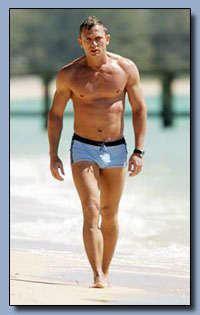
Daniel Craig is a new kind of Bond. His startlingly blue eyes, not to mention his Bowflex physique, expose a vitality and physical presence that surpasses even Sean Connery (though it’s slightly hampered by the frequent Derek Zoolander impersonation). Still, Craig’s vitality shines through a rough exterior that is sometimes lacking in the debonair luster of previous Bonds.

One early scene perfectly captures the new Bond’s effective yet unpolished manner. In the scene, Bond pursues a demolitions expert into a construction site. The man becomes cornered in a small room but adroitly flips through a small, elevated window. Bond ignores the window and instead runs straight through the newly constructed wall, splintering wood and plaster everywhere.

Pecs. Check. Biceps. Check. Six pack. Check. Fluffy Chest Hair...

Daniel Craig’s roughshod manner is actually quite appropriate for Casino Royale though many people won’t realize it.

Despite a few early references, the film largely glosses over the fact that Casino Royale marks the very first appearance of James Bond. Creator Ian Fleming wrote a number of stories about the British spy with Casino Royale as the first. Consequently, Bond has just been promoted as a “double-O” operative and it shows. His skills are already world class, but his judgment isn’t always perfect and a new emotional vulnerability peeks out from time to time. These flaws add a brand new dimension to the Bond franchise.

Perhaps for the first time, James Bond is a real character with meaningful weaknesses and imperfections. Even with Sean Connery, James Bond was never more than a dashing black tux; a tux that could kill men and seduce women with ease, but one incapable of indecision and reflection. In one scene from Casino Royale, Daniel Craig pauses to study his mirrored image after killing an assailant. The hinted vulnerability reveals the price for his constant composure. This serious side of James Bond hasn’t gotten much attention before and its appearance is just one of many changes in the 007 franchise.

The excessive camp and groan inducing puns of the Brosnan films have been thankfully discarded, but don’t worry too much because director Martin Campbell has infused Casino Royale with a much more intelligent and sharper sense of humor. Also new is an honest to goodness relationship between Daniel Craig and the latest “Bond girl,” Vesper Lynd (played by a reasonably deft Eva Green). Watching their relationship develop is one of the surprising joys of the film but their chemistry does occasionally falter. The action sequences also come off well, thanks in large part to Daniel Craig’s obvious athleticism.

Casino Royale isn’t without flaws. As charismatic as Daniel Craig is, he doesn’t quite have the confidence and assurance of a Pierce Brosnan (not to mention Sean Connery). In more than one scene James Bond does not look as composed as he should and not all of these momentary weaknesses seem part of the script. Playing along with the theme of a James Bond coming into his own, the music often teases at playing the famous Bond theme before finally giving in. But besides the catchy theme, most of the music is generic and forgettable. Action scenes in particular receive poor musical accompaniment. And despite the film’s emphasis on character development, the bad guys are both banal and bland.

Ironically, Casino Royale’s plot is completely insignificant despite being penned by creator Ian Fleming. The key to the film and the franchise has always been James Bond and everything else, plot included, has always been secondary.

Daniel Craig is mostly successful as the newest incarnation of the Suited One. His physical demeanor is tastefully offset by a dry wit and a lighter arrogance than previous Bonds. Casino Royale is smart and stylish enough that fans will still hang around for this grittier and more realistic (in a way) 007. And now when discussing the best Bond actors, Daniel Craig deserves a word in the conversation, even if he is short on fluffy chest hair.

With my new rating system, Casino Royale gets a "Paul." Better than a George and Ringo but not quite good enough for a John.

11.13.2006

True Story:
Stranger than Fiction
is good


My dad and I have a running joke that half of all movies are in some way “based on a true story” or “inspired by true events.” And oftentimes by relying on the “inspirational” nature of these (invariably) dramatic movies, they become bland and predictable; before your little tooshie hits the seat you already know the guy makes the football team, the girl wins the case, the horse wins the race, and the deer catches the bullet with it’s face.

Fortunately, Stranger than Fiction takes the “inspired by true events” concept and turns it completely on it’s head. The result is an understated, funny, and surprisingly deep film that adeptly avoids the clichéd and commonplace.

The synopsis: A troubled writer (Emma Thompson) struggles to kill off her book’s main character, a methodical, lonely man named Harold Crick (Will Ferrell). Without warning or explanation, the writer’s foreboding narration descends upon the real-life Harold Crick (this is the “inspired by true events” part), triggering a rash of decisions and changes.

Let me get out one last warning (last one, I promise): this movie is not Talledega Nights, Elf, Old School, or Anchorman. If you walk into Stranger expecting to see drunk, naked men or guys getting high on tranquilizer darts then you will be disappointed. This isn’t to say there aren’t any laughs, because there are many, but the laughs in Stranger than Fiction are there because they punctuate the storyline and not the other way around.

I’d really like to explain exactly how Stranger than Fiction spins, punctuates and wraps up it’s storyline, but then I’d be robbing you of a lot of what makes this movie so special. Also, the plot defies cute, packaged descriptions. Suffice it to say, the storyline is unique and original and the characters are memorable and heartfelt in their actions and emotions.

Stranger Than Fiction has a lot of truth, just like my buddy Col. Jessep

Along those lines, Will Ferrell is superb as Harold Crick. Ferrell’s trademark humor and zaniness often lurks just beneath Harold’s blank surface but it creeps out often and to great effect. The film’s understated dialogue successfully emphasizes rather than restrains Will Farrell’s considerable comic abilities and on the whole, the dialogue crackles with sharp barbs, poignant asides, and textured conversations that are all too rare in recent films.

Emma Thompson and Dustin Hoffman also turn in excellent performances. Thompson is always a wonderful actress and her work here is no departure from the norm. On the other hand, I’ve been disappointed with several of Dustin Hoffman’s recent works (Meet the Parents 2), but his role as Professor Hilbert is restrained, smart, and very funny. Maggie Gyllenhaal also deserves praise despite a slightly uneven performance.

You’ll probably want to see Stranger than Fiction because of Will Ferrell, and rightfully so. But if you’re expecting a brainless Will Farrell flick, you’ll probably miss out on what’s in front of you; an excellent, understated film with a fair dose of humor and heart.

And that’s the truth.

11.09.2006

Weeds burns with bright wit and rich, flavorful plots
(without lowering your sperm count)


Shows like Weeds are the reason God created Netflix. All too often a television series will settle into a monster of the week (X-Files) or crime of the week (CSI:Miami) storyline that begins and ends in a convenient yet unfulfilling one-hour package. Weeds takes a refreshing break from that stuffy mold while following the never-ending and often hilarious trials of a pot-dealing single mother.

As a recently widowed mother of two, the ends just won’t meet for Nancy Botwin (Mary Louise Parker) and dealing offers the only respite. And dealing in suburban America offers its own set of difficulties, as relentless gossip and PTA intrigue can wreak havoc on a growing drug empire. Nancy must wrestle with the pain of her husband’s tragic death, the difficulties of raising two growing boys, and the unending pressure to survive the law and her drug dealing competition. It’s fun, hilarious, dark, and tragic. It’s also great television.

Light 'er up baby

The secret ingredient of Weeds is its truly amazing cast of characters. Talents like Mary Louise Parker (Boys on the Side), Elizabeth Perkins (He Said, She Said), and Romany Malco (The 40 Year Old Virgin) lay on the drama, energy, and sarcasm so well it’s got to be unhealthy. And the final proof of Weeds’ comedic chops is how even Kevin Nealon (SNL) manages to shine as a supremely mellow PTA President/pothead.

Mary Louise Parker alone could carry this show as the multi-layered, eponymous pot dealing mom. Vulnerable and frightened or tough and capable, Mary dances through her roles with grace, aplomb, and a sarcastic jibe waiting to dart from her lips. And every bit of Mary Louise Parker’s considerable acting ability is necessary because her character, Nancy Botwin, is on one hell of a rollercoaster ride.

In one memorable scene, Nancy confronts a competing dealer who has pushed some product onto a ten year old. Clearly enraged, Nancy seems just as surprised as the dealer when she physically threatens him to stop dealing to children. I won’t spoil how this altercation ends, but the surprise and intensity of the scene remains just as believable and captivating as the humorous banter between Nancy and her queen-bitch neighbor played by Elizabeth Perkins.

Be warned however that Weeds is not fun for the whole family. Teenaged sex, adultery, not to mention drug dealing and drug use are constantly on screen and in your face. And at times the series can drop into the realm of tragedy with a bluntness that isn’t appropriate for everyone. I wouldn’t recommend watching Weeds in front of your impressionable children or religious mother-in-law with the Jesus tattoo on her back.

As much as I want to go on with my glowing and fantastically written review, I’m afraid I’ll spoil the plotlines and ruin the mellow you’ll get from this sure-fire hit. With any luck, you’ve already taken my advice and ordered the first season’s DVD, but second season is off-limits because it’s not out yet and I have first dibs.